
Most link building starts with an ask. You find a page you’d like a link from, email the editor and hope they say yes. When you’re a small or bootstrapped brand with little reputation, that ask often goes nowhere.
There’s another way to start: give first. Publish a roundup that genuinely celebrates the best tools, people or resources in your industry. The brands you feature now have a reason to notice you, share your work and, often, remember you when they next update their own resources. You’ve created goodwill before you’ve asked for anything.
This approach is sometimes called “ego bait”, because people naturally pay attention when they’re recognised. A well-executed Reciprocal Roundup Strategy takes this idea further by combining valuable content with genuine relationship building. Done cynically, it’s a thin trick that experienced marketers spot instantly. Done well, it’s simply good community building: you create something useful, credit others properly and build relationships that lead to links, partnerships and visibility over time.
This guide is for content strategists, community builders and bootstrapped founders who want to use their own listicles to earn authority. It covers how to build a roundup worth featuring in, how to turn features into relationships without making inclusion feel transactional, and how to partner with complementary tools without falling into risky link swaps.
⚡
◴ ~20 sec read
Publishing your own well-researched listicles can help you earn quality backlinks, build industry authority and develop valuable relationships with relevant brands.
Instead of requesting links immediately, create useful roundups, feature deserving businesses and notify them without expecting anything in return. As relationships grow, opportunities for resource page mentions, natural backlinks and co-marketing partnerships may follow.
Focus on transparent selection criteria, accurate information and genuine collaboration rather than reciprocal link exchanges or traded rankings.
The key to long-term success is creating valuable content, building trust and earning links naturally.
Why Publishing Your Own Roundup Works
Publishing your own listicle flips the usual outreach dynamic in a few useful ways:
- You start with value, not a request. Featured brands receive something positive before you ask them for anything.
- You become a curator in your space. A well-researched roundup positions you as someone who knows the landscape, which builds trust with readers and peers.
- It creates natural reasons to connect. Telling someone they’ve been featured is one of the easiest outreach messages to send.
- It can rank and attract links on its own. A truly comprehensive roundup can earn citations from people who simply find it useful.
- It supports AI visibility. Comparison and roundup content is often drawn on by AI search tools, and being the publisher of a respected roundup can strengthen your association with the category.
The opportunity to earn High-Authority Backlinks depends on the roundup being genuinely useful, credible and relevant to its audience. A thin list written only to bait links will be ignored, and in some cases it can damage your credibility. Quality content and genuine editorial value matter more than the authority of any individual linking website.
Part One: Building the Trojan Horse
The phrase “Trojan horse” is useful shorthand, but the best roundups aren’t disguises. They’re valuable in their own right. Effective Listicle Link Building starts with publishing useful, carefully researched content that readers appreciate and featured brands have a genuine reason to acknowledge. The leverage comes from helping readers and recognising others at the same time.
Choose a Topic With Real Demand
Start with a roundup people actually want to read. Good options include:
- Tools for a specific audience, such as “The Best Accessibility Tools for Small E-commerce Sites”
- Resources for a specific task, such as “Free Templates for Freelance Contracts”
- Experts or creators, such as “Newsletters Every SaaS Marketer Should Read”
- Integrations within a stack, such as “Tools That Integrate With Shopify for Subscription Businesses”
Check search demand with an SEO tool, look at what already ranks, and ask whether you can genuinely produce the most useful version. If the top results are already excellent and comprehensive, choose a narrower angle where you can add more.
Make It Comprehensive and Fair
A roundup earns respect when readers can trust it. That means:
- Clear selection criteria. Explain how tools were chosen, such as relevance, features, pricing, support or user reviews.
- Fair representation. Include strong options even if some compete with you indirectly. A list that only features your friends looks biased.
- Consistent evaluation. Describe every entry using the same structure, such as “Best for”, “Key features”, “Pricing,” and “Limitations”.
- Accurate, current details. Verify pricing, plans, and features on each brand’s own site before publishing.
- Honest methodology. If you haven’t tested every tool hands-on, say so and describe your research process accurately.
Handle Your Own Product Transparently
If your product belongs in the category, you face a credibility test. A few ways to handle it:
- Disclose clearly that you make one of the tools featured.
- Avoid automatically ranking yourself first. Consider an unranked or categorized format instead.
- Apply the same criteria to yourself, including an honest limitation.
- Consider leaving yourself out if your presence would undermine trust in the list.
Readers forgive a disclosed relationship. They don’t forgive one they discover later.
Add Something Others Can’t
The roundups that attract links and attention usually offer something extra:
- Original data, such as a short survey of users in the category
- A comparison table covering features and pricing across every entry
- Expert quotes from the people or brands featured
- A free downloadable version, such as a spreadsheet or checklist
- Regular updates, with a clear “last updated” date
These additions make your roundup more citable and give featured brands more reasons to share it. When Publishing Listicles for Backlinks, original research, practical comparisons and expert contributions can give other publishers a genuine editorial reason to reference your content rather than simply acknowledge their inclusion.
Plan for Maintenance
A roundup is only as useful as its accuracy. Schedule regular reviews to update pricing, remove discontinued tools and add strong newcomers. An outdated roundup loses its value quickly, and with it the goodwill it created.
Part Two: The Feature-to-Ask Pipeline
Once your roundup is live, the people and brands you’ve featured have a genuine reason to hear from you. A successful Listicle-Based Outreach Strategy begins with personalised communication that acknowledges their contribution without immediately requesting a backlink. The key is to make that first contact purely about recognition, then build the relationship naturally from there.
Step One: Notify Featured Brands
Send a short, personal note to each brand you’ve featured. Find the right person, such as a marketing lead, community manager or founder, rather than a generic inbox.
Subject: You’re featured in our guide to accessibility tools for small online shops
Hi Maya,
Just a quick note to let you know we’ve included Contrastly in our new guide to accessibility tools for small e-commerce sites. We highlighted it as the best option for checking colour contrast across product pages.
Here’s the link in case you’d like to see it. If any of the details need updating, just let me know and I’ll fix them.
Thanks for building such a useful tool.
(Contrastly is a fictional example.)
Notice what this email doesn’t do. It doesn’t ask for a link, a share, or anything else. It recognizes their work and invites corrections, which also helps keep your roundup accurate.
Step Two: Make Sharing Easy With a Media Kit
Many brands like to share recognition with their audience. Make it effortless by offering a simple media kit:
- A short description of why they were featured, in a sentence they can quote
- A ready-made social post with the correct link and tags
- A clean graphic showing their inclusion, sized for common platforms
- An optional badge they can use on their website
- Usage guidance, such as how to describe the feature accurately
Offer this as a convenience, not an obligation. Some brands will use it, many won’t, and that’s fine.
Handling Badges Responsibly
Badges such as “Featured in [Your Brand]’s Best Accessibility Tools” can be useful, but they need care. Google’s spam policies specifically mention links embedded in widgets and distributed across many sites as a potential link scheme, especially when they’re keyword-rich or hidden.
To keep badges on the right side of that line:
- Never require a badge or link as a condition of being featured.
- Use a branded, visible link rather than a keyword-stuffed anchor.
- Tell recipients they’re welcome to use
nofollowor display the badge without a link. - Avoid hidden links in the badge’s embed code.
A badge’s real value is recognition and referral traffic. If it brings links too, they should be ones the site owner chose to give.
Step Three: Build the Relationship
Over the following weeks, look for natural ways to stay in touch:
- Share their updates or launches when they’re genuinely relevant to your audience.
- Update their entry promptly when they release new features.
- Invite them to contribute a quote or tip to a future article.
- Engage with their content on social media or in community spaces.
The goal is to become a familiar, helpful contact rather than someone who appeared once.
Step Four: Make the Inclusion Request
Once a relationship exists, an inclusion request feels natural rather than transactional. Many brands maintain resource pages, integration directories, partner lists or “recommended tools” sections that can provide relevant Editorial Backlink Opportunities. If your product or content genuinely fits one of these, you can suggest it, allowing the publisher to decide independently whether it deserves inclusion.
Hi Maya,
I noticed your resource page for new store owners includes a section on improving checkout accessibility. We recently published a free guide to writing accessible product descriptions, which might be a useful addition there.
No pressure at all. I just thought it might help your readers.
A few principles keep this healthy:
- Only ask where you genuinely fit. Relevance matters more than the relationship.
- Never link the ask to your original feature. Their inclusion in your roundup should stand on its own merits.
- Suggest a specific page and placement, so the request is easy to evaluate.
- Accept a no gracefully. The relationship is worth more than any single link.
Part Three: Cross-Promotional Swaps (Done the Right Way)
Partnering with complementary, non-competing tools is one of the most effective ways for small brands to grow together. An email marketing tool and a CRM, a scheduling app and a video-call platform, or an invoicing tool and an accounting app often share the same customers.
The opportunity is real. But this is also where the strategy most easily crosses into risky territory, so it’s worth being precise about what works.
Where Simple Swaps Go Wrong
“I’ll put you at the top of my list if you put me at the top of yours” may sound efficient, but it creates three problems:
- Google treats excessive link exchanges as link spam. Its spam policies explicitly list “link to me and I’ll link to you” arrangements made primarily for cross-linking.
- It misleads readers. A “best tools” list where positions are traded rather than earned no longer reflects an honest recommendation.
- It can breach advertising and consumer rules. In the UK, the CAP Code and consumer protection law require commercial relationships that affect content to be clear to readers. In the US, FTC guidance takes a similar approach.
Occasional, natural links between businesses that work together are normal. However, Reciprocal Link Building becomes problematic when websites exchange links primarily to manipulate search rankings rather than help readers. Systematic swaps of top-spot placements are not a sound editorial practice and can undermine both search visibility and audience trust.
What Good Co-Marketing Looks Like
The safer and more effective approach is to collaborate on content that genuinely serves your shared customers:
- Integration guides. “How to connect your CRM and email tool to automate follow-ups” helps users of both products and naturally references both.
- Joint webinars or workshops, each promoted to both audiences and summarised on both blogs.
- Co-authored research, such as a survey of your shared customer base, published by both partners.
- Guest contributions, where each brand writes a genuinely useful article for the other’s blog on a topic it knows well.
- Shared templates or toolkits, such as a sales follow-up template that uses both products.
- Partner and integration directories, where each brand lists the other because they really do work together.
In each case, the content stands on its own merit, and any links exist because they help readers, not because they were traded.
Choosing the Right Partners
Look for partners that:
- Serve the same customer but don’t compete with you
- Integrate with your product, or are commonly used alongside it
- Have an engaged audience, not just a high-authority domain
- Share your standards for quality and honesty
- Bring complementary expertise to joint content
Partnerships with real product integrations are especially valuable because content about how tools work together is genuinely useful.
Keeping Partnerships Transparent
- Disclose partnerships where they affect content, such as “We partner with [Brand] on this integration.”
- Keep editorial lists independent. If you publish a “best CRMs” roundup, partners should earn their position on the same criteria as everyone else.
- Agree expectations in writing, covering what each side will create and promote.
- Avoid reciprocal link quotas. Agree on content and promotion, not on link counts or anchor text.
Scaling Without Losing Integrity
As these programs grow, it becomes harder to track which relationships, features and partnerships are in play, and easier for well-meant collaboration to drift into transactional swaps. Agencies such as Megri Outreach tend to keep owned roundups, co-marketing, and external outreach clearly separated within a single editorial outreach strategy, so that partner relationships support genuine publisher relations rather than compromise them. Whether you manage this in-house or with a partner, documenting every relationship and keeping your editorial criteria consistent is what protects your credibility.
Bringing It All Together
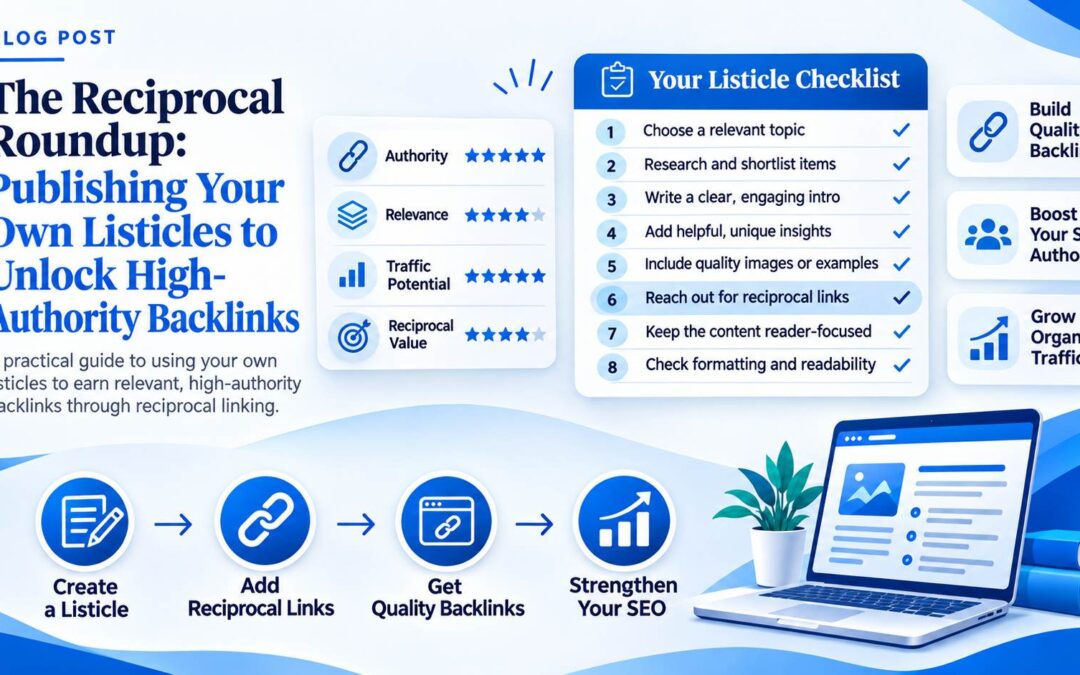
These three approaches work best as a cycle:
- Publish a high-value roundup that recognises the best in your space.
- Notify featured brands and make it easy for them to share the recognition.
- Build relationships through useful, ongoing contact.
- Suggest inclusion on their resource pages where you genuinely fit.
- Develop co-marketing partnerships with complementary tools that share your audience.
- Feed new partners and insights back into future roundups, judged on the same criteria as everyone else.
Each cycle strengthens your reputation as a curator, collaborator, and trusted voice in your category.
Measuring Success
Track results across the full pipeline:
- Roundup performance: rankings, organic traffic, and links earned by your own listicle
- Share rate: how many featured brands share or reference their inclusion
- Relationship growth: featured brands you remain in regular contact with
- Resource page inclusions: links or mentions earned on others’ resource pages
- Co-marketing outputs: joint content published and the traffic it generates
- Referral traffic and conversions from partner and resource placements
Look at these over quarters rather than weeks. Unlike short-term Authority Link Building Tactics focused primarily on acquiring links, relationship-led outreach measures success through relevant editorial mentions, referral traffic, sustained partnerships and audience engagement. These results may develop gradually, but they provide a stronger foundation for long-term visibility.
Common Mistakes to Avoid
- Publishing a thin roundup that exists mainly to bait links
- Ranking yourself first without disclosure or fair criteria
- Requiring links or badges in return for being featured
- Asking for a link in the first email
- Trading top-spot placements with partners
- Letting the roundup go stale after the initial outreach
- Hiding commercial relationships from readers
FAQs
What is ego-bait content?
⌄
Can I include my own product in a roundup I publish?
⌄
Is it acceptable to ask featured brands for a link?
⌄
Are badges for featured brands safe for SEO?
⌄
nofollow if they prefer. Google’s spam policies warn against manipulative links distributed through widgets.Are link exchanges with partners against Google’s guidelines?
⌄
What kinds of co-marketing work best for complementary tools?
⌄
Conclusion
Publishing your own roundup is one of the most practical ways for a smaller brand to build authority from scratch. It lets you lead with value: you recognize others first, show your knowledge of the market and create genuine reasons to connect.
The approach works when you keep it honest. Earning Backlinks Through Roundups requires fair selection criteria, comprehensive content, regular updates and authentic relationships with featured brands. Notify businesses without strings attached and let relationships develop naturally before asking for anything. Partner with complementary tools on content that helps your shared customers rather than trading list positions. Over time, that reciprocity grows into something far more valuable than a handful of swapped links: a network of trusted relationships and a reputation that earns attention on its own.