
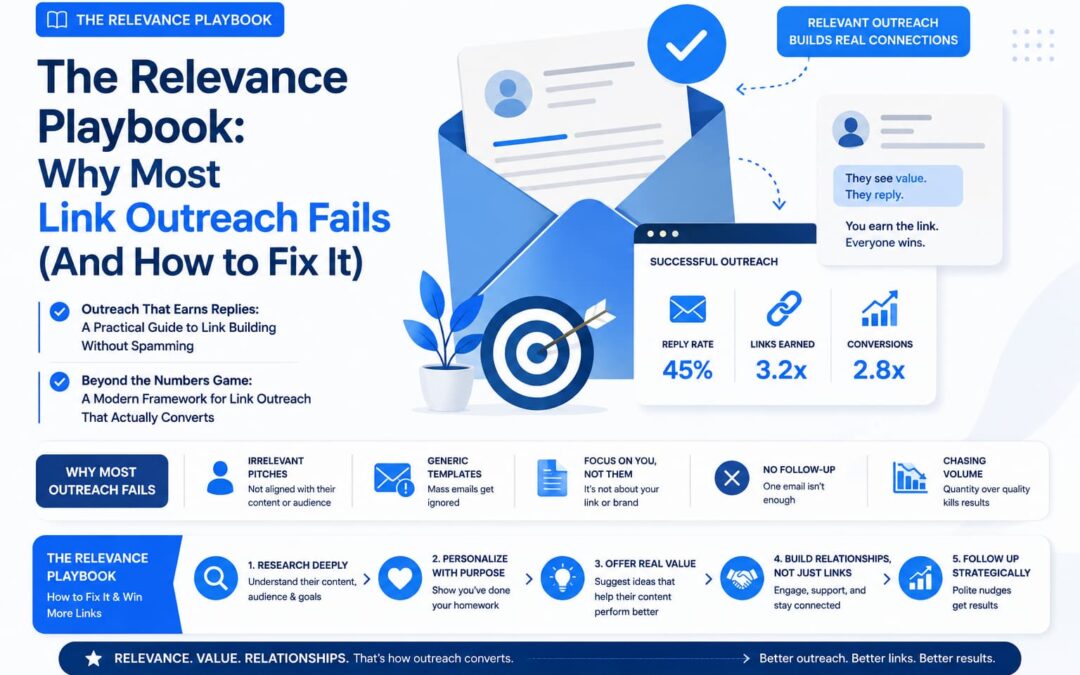
Link outreach fails for one reason more often than any other: it asks a stranger to do unpaid work without giving them a reason to care. Most teams try to fix this with more volume — bigger lists, faster sends, heavier automation — when the real fix is narrower and more deliberate. Outreach that converts is built on relevance, a message that reads as if it came from a person, and a system that tracks relationships instead of just links.
This guide breaks down exactly how to get there — from list quality and pitch structure, to deliverability and long-term relationship management — so you can run outreach that earns replies instead of getting deleted.
Key Takeaways
- Successful link outreach depends on relevance and prospect research, not send volume — a smaller, well-qualified list consistently outperforms a larger, generic one in actual link building results.
- List quality and prospect qualification determine outcomes before a single pitch is written, and markets with little independent publishing may respond better to digital PR than cold email outreach.
- Response rates decline as outreach volume increases, and low-quality sending damages sender reputation, burns prospects, and quietly suppresses future campaign performance.
- A high-converting outreach email is built around a specific, checkable observation about the recipient’s site, a clear benefit to them, one explicit ask, and a low-pressure exit line.
- Effective subject lines and email structure matter as much as the pitch itself — specific, descriptive subject lines outperform vague or salesy ones, and templated language is easy for editors to spot.
- A disciplined follow-up sequence in link placement outreach (one standard follow-up, a second only with new information, then stopping) recovers replies without tipping into harassment or damaging the sender-recipient relationship.
- Email deliverability fundamentals — SPF, DKIM, DMARC authentication, a dedicated sending domain, and proper warmup — are essential, since even a well-written pitch fails if it never reaches the inbox.
- Long-term outreach success relies on relationship tracking, not just link acquisition — logging outcomes, reasons, and re-contact dates helps recover lost links and turn “not now” replies into future wins.
1. Introduction: Rethinking Outreach
Why “send more” doesn’t equal “get more”
The standard outreach model via blogger outreach, guest posting, and listicle outreach treats results as a function of volume: send a thousand emails, and you’ll get ten times the links of a hundred. In practice, response rate isn’t fixed — it drops as volume rises, because the tactics used to scale (merge fields, generic templates, looser targeting) are the same tactics that kill relevance. A smaller, sharper campaign frequently outperforms a larger, looser one in absolute results, not just efficiency.
The real problem: relevance, not volume
Every recipient of a cold outreach email is asking one silent question: why me? If the answer isn’t obvious in the first sentence, the message gets deleted before the pitch is even read. Outreach that converts starts from research, not reach. It identifies a genuine reason a specific person should care, then writes to that reason. Everything else — subject line tricks, send-time optimization, personalisation tokens — is decoration on a request that has no real foundation underneath it.
2. Before You Send: The Prerequisite Work
Why list quality determines outcome before you write a word
No amount of skilful writing rescues a poorly built list. If your prospects were pulled from a keyword export and addressed to generic inboxes or outdated contacts, the campaign is compromised before the first email goes out. Strong outreach depends on a qualified list: named individuals, current roles, and sites where a link genuinely fits the existing content. This groundwork takes longer than writing the pitch itself, but it’s what separates a campaign that gets replies from one that gets silence.
Identifying markets that simply don’t link back
Not every industry publishes content the way SEOs assume. Some verticals have almost no independent blogging, thin trade press, and no maintained resource pages — regardless of how good your outreach is. In these markets, high-volume outreach becomes a slow way to lose money and time. If your research turns up nothing but aggregators and directory listings, that’s a signal to shift strategy toward digital PR aimed at adjacent audiences, rather than continuing to push cold email at a market that structurally doesn’t respond to it.
3. The Economics of Bad Outreach
How response rate actually behaves as volume increases
Conversion rate isn’t a fixed property of a market — it’s a property of how well the message fits the recipient, and that fit erodes the moment you try to scale it. Widening a list to hit a sending quota, or swapping personal research for a merge field, doesn’t just lower your rate — it can shrink your total results even as the number of emails sent goes up. Sustainable outreach treats volume as a constraint to manage carefully, not a lever to pull whenever results feel slow.
Hidden costs: sender reputation, prospect burn, team morale
Poor link-building outreach doesn’t just fail quietly — it compounds. Low engagement and spam complaints train mailbox providers to filter your domain, which suppresses delivery on future campaigns in ways that are invisible until you investigate. Prospects who delete one bad pitch remember the sender, making a genuinely good pitch months later start from a deficit. And teams that send into silence long enough start optimising the wrong variables entirely — tweaking subject lines when the real issue is list quality or deliverability.
4. Diagnosing Outreach Failure
Reading rejection from the recipient’s side
Put yourself in the inbox of someone who publishes regularly. They receive near-identical pitches weekly: a vague compliment, a resource pitch framed as a favour, a promise to “share with our audience.” Recognition happens in seconds, often before the email is even fully read, because the recipient is pattern-matching against a batch of similar messages, not evaluating your argument on its merits. Your email isn’t judged in isolation — it’s judged against the last forty pitches they deleted that month.
The tells that expose a templated email
Recipients are far better at spotting automation than most senders assume. The giveaways are consistent: unspecific praise that could apply to any article, visible merge-field errors, references to the wrong page or an outdated post, hollow offers to “share on our channels,” and automated follow-ups sent to someone who clearly already saw and ignored the first message. None of these is fixable with better wording — they’re symptoms of a message written without real knowledge of the recipient.
Three root causes: wrong person, wrong ask, no reason
When a campaign underperforms, the cause almost always falls into one of three buckets. Wrong person means the email reached a shared inbox or someone without authority over the page — symptom: total silence, no bounces. Wrong ask means the right person got a request they can’t or won’t fulfil — symptom: polite refusals or clarifying questions. No reason means the request was doable, but the recipient had no motivation to act — symptom: opens with zero replies, and often the hardest problem to fix because it may require rethinking the pitch entirely.
5. Writing a Pitch People Actually Read
The four jobs every outreach email must do
An effective pitch accomplishes four things before the reader’s attention runs out: it proves a human wrote this specifically to them, gives them a reason that serves their interest (not yours), makes one small and explicit ask, and offers a clean, low-pressure exit. That last point matters more than it sounds — telling someone “no reply needed if this isn’t useful” removes obligation, and removing obligation is often what makes people more likely to respond, not less.
A sentence-by-sentence structure that works
A strong cold pitch fits in four to six sentences. Open with a specific, checkable observation about their site — not a compliment. Follow with why it matters to them or their readers. State what you have in one line, without describing your company. Make the ask explicit and singular. Close with permission to ignore the email. Sign off with a real name, role, and site — not a marketing footer. This structure keeps the email scannable on a phone screen while doing all the necessary persuasive work.
Subject lines: what earns an open vs. what gets deleted
The best subject lines describe, in six or seven words, a specific fact about the recipient’s own site — a broken link, an outdated entry, a missing resource. Sentence case, no emojis, no false urgency. Phrases like “Quick question,” fake “Re:” prefixes, or anything mentioning “partnership” or “opportunity” are instantly recognisable as outreach and routed straight to the delete pile, regardless of how good the email underneath actually is.
What to cut before sending
Draft first, then cut by roughly a third. The parts that almost always need to go: a lengthy self-introduction (your signature already covers this), an extended justification for why your resource is valuable, a hollow reciprocal offer to share their content, and a second ask tacked onto the first. Each of these turns a two-minute decision into a bigger commitment, which is exactly what causes recipients to do nothing at all.
6. Follow-Up Without Becoming a Nuisance
How many follow-ups, and when
Non-reply is usually a timing problem, not a rejection — people are busy, on deadline, or simply missed the email. One well-placed follow-up recovers a meaningful share of those replies. A sound policy is one follow-up as standard, sent four to seven days after the original, and a second only if there’s genuinely new information to share, spaced ten to fourteen days later. After that, stop. Sending a third follow-up rarely reflects a real reason to reach out again — it usually reflects pressure to hit a number.
What a good follow-up says (vs. a bad one)
A weak follow-up simply repeats the ask: “Just bumping this to the top of your inbox.” A strong one does one of three things — adds new information, reduces the size of the ask to make it easier to answer, or closes the loop cleanly by stating this is the last message on the topic. Reply within the original thread so context carries over, and never imply a prior relationship or conversation that didn’t happen.
Recognising when to stop
Certain signals should end a sequence immediately regardless of how many follow-ups remain in your policy: any form of “no,” an irritated reply, a direct request to be removed, or discovering the prospect isn’t actually a fit after a closer look. Stopping isn’t a failure — it’s a professional judgment call, and recording why you stopped (not just that you did) helps prevent a colleague from re-adding that contact months later.
7. The Technical Side: Getting Your Email Delivered
SPF, DKIM, DMARC explained simply
These three DNS records form the authentication layer that major mailbox providers now expect from anyone sending at volume. SPF lists which servers are authorised to send on your domain’s behalf. DKIM attaches a cryptographic signature proving a message wasn’t altered in transit. DMARC tells receiving servers what to do when SPF or DKIM checks fail, and reports back on unauthorised senders. None of these guarantees your email will be welcomed — they simply prove you are who you claim to be, which is a prerequisite, not a guarantee of inbox placement.
Why a separate sending domain matters
Running outreach from your primary business domain risks your invoices, support replies, and sales mail if reputation degrades. Using a dedicated, honestly branded sending domain contains that risk, gives you a clearer read on your outreach-specific reputation, and gives you a recovery path if something goes wrong — a burned outreach domain can simply be retired, while a burned primary domain is a much bigger problem to fix. This is one of the areas where agencies with established outreach infrastructure have a real advantage: Megrisoft UK and Submitshop service, for example, run outreach through properly warmed, dedicated sending domains rather than a client’s core business domain, which keeps day-to-day business email untouched by campaign performance.
Warming up a new address the right way
A brand-new domain sending high volume immediately looks exactly like a compromised account to mailbox providers. Warmup means starting with a handful of messages a day, increasing gradually over several weeks, and prioritising genuine replies over raw volume — engagement is the strongest positive signal a provider can see. Automated warmup services that simulate engagement between mailbox pools are worth approaching cautiously, since providers have gotten better at detecting and discounting that kind of activity.
Diagnosing silent delivery failures
If a campaign produces zero replies, zero bounces, and zero refusals after more than about thirty sends, suspect a delivery problem before rewriting the pitch. Check that authentication is actually passing (not just published), read your DMARC reports, test inbox placement across major providers, and check the sending domain and IP against public blocklists. Content factors like tracking pixels, link shorteners, and large attachments are worth reviewing only after ruling out the technical causes first.
8. Managing Outreach Relationships at Scale
Building a tracking system your team will actually maintain
Most teams start with an ambitious CRM, use it properly for a few weeks, then quietly drift back to a spreadsheet once a campaign gets busy. The fix isn’t a better tool — it’s fewer, better-chosen fields. Track only what has a named person who will actually read it: domain, contact details, source of the contact, reason for the pitch, date first contacted, outcome (from a fixed list of options), their stated reason, and a next-action date. An accurate five-column sheet beats a CRM that’s only half filled in.
Recording relationships, not just links
Most systems record the artefact — the link — and discard everything else: the refusal with a reason, the “not now, ask me later,” the counter-offer. That discarded information is often more useful than the wins, because it tells you what to do differently next time and who’s worth re-contacting. A prospect who declined politely and explained why is a warmer lead than a stranger, and treating them that way is what separates a relationship-based outreach program from a one-off blast.
Running a re-contact cycle for “not now” replies
Contacting people you’ve already spoken to is consistently one of the highest-return activities in outreach, and it’s the one most teams skip because campaigns end and spreadsheets get archived. Build a recurring cycle around three groups: people who said “ask again later” (diary the exact date they gave), agreed links that never went live (check at two and six weeks), and links that were live but have since disappeared. Quarterly review is a reasonable cadence, and an established outreach partner like Megri Outreach typically builds this re-contact workflow directly into a campaign’s reporting cycle, so warm leads don’t get lost when a project wraps up.
Why links disappear even when pages don’t
Link loss is usually a human decision, not a technical one. Pages get redesigned, migrated to new content management systems, or edited by someone who doesn’t know why a particular link was there in the first place — and in the large majority of cases, the source page itself never actually goes offline; it’s simply edited. This is why a relationship matters: someone who knows you at that publication is more likely to notice and preserve the link during a redesign than an anonymous URL sitting in a database ever would.
9. Conclusion: What Sustainable Outreach Looks Like
Signs a campaign is working
A healthy campaign doesn’t just produce links — it produces real refusals with reasons attached, questions and counter-offers instead of silence, and occasionally unprompted mentions months later from someone who remembered a genuine exchange. These are signs that actual humans are reading and engaging with your outreach, which is the foundation everything else is built on. A campaign generating total silence, regardless of how well-written the pitch is, points to a list or deliverability problem rather than a messaging one.
A checklist to run before every send
Before launching any campaign, confirm every prospect is a named individual (not a shared inbox), write one specific reason per prospect for why they’d care, cut your draft pitch by a third, read it aloud and rewrite anything that sounds like marketing, verify SPF, DKIM, and DMARC are passing on your sending domain, cap daily volume per address, and decide your follow-up policy in advance rather than in the moment. Run through this list every time — skipping it is how a well-intentioned campaign quietly burns a domain’s reputation.
Next step: Pick your last completed outreach campaign and pull the actual outcomes — not the number of emails sent, but how many were refusals with a reason, how many bounced, and how many got no response at all. That single audit will tell you immediately whether your next campaign needs a better pitch or a fundamentally better list and delivery setup.
FAQ on Link Outreach
What is link outreach in SEO?
Link outreach is the process of contacting website owners, editors, or content creators to request a backlink to your site, usually in exchange for value like a resource, correction, or expert insight. It’s a core tactic in off-page SEO, used to build domain authority, referral traffic, and search visibility through earned, editorially placed links rather than paid or automated ones.
Why does most link outreach fail to get replies?
Most link outreach fails because it doesn’t give the recipient a specific reason to care. Generic templates, vague compliments, and merge-field personalisation are instantly recognisable to experienced editors and get deleted within seconds. Outreach succeeds when it’s built on real research — a specific observation about the recipient’s site — rather than volume or persuasion tactics alone.
How many follow-up emails should I send after an outreach pitch?
One follow-up is standard practice, sent four to seven days after the original email. A second follow-up is only worth sending if you have genuinely new information to add, spaced ten to fourteen days later. Sending a third follow-up rarely improves results and usually signals pressure to hit a number rather than a real reason to reach out again.
What is a good response rate for link building outreach?
There’s no universal benchmark, since response rate depends heavily on list quality, niche, and outreach tactic. A more useful indicator than a percentage is response quality: getting refusals with reasons, questions, or counter-offers means real people are reading and engaging with your pitch, which matters more than chasing a specific numeric target.
Why should I use a separate domain for outreach emails?
A separate outreach domain protects your primary business domain’s sender reputation. If an outreach campaign triggers spam complaints or low engagement, only the dedicated domain is affected — your invoices, support replies, and sales emails keep landing in inboxes normally. This separation also makes it easier to warm up, monitor, and recover outreach-specific deliverability issues.
What are SPF, DKIM, and DMARC, and why do they matter for outreach?
SPF, DKIM, and DMARC are DNS-based email authentication records that verify a message genuinely came from your domain and wasn’t altered in transit. Major mailbox providers now require all three for bulk senders to reach the inbox reliably. Without them, even a well-written outreach email risks being filtered into spam before a recipient ever sees it.
How do I track link outreach without losing important details?
Track outreach using a simple system with a fixed set of fields: contact name, domain, reason for the pitch, date contacted, outcome, and a next-action date. A small, consistently updated spreadsheet is more reliable than a complex CRM with unused fields, since incomplete data quickly becomes untrustworthy and gets abandoned by the team.
Ready to Put This Into Practice?
Building and running a qualified outreach program takes time most in-house teams don’t have — the research, the warmed-up sending infrastructure, and the relationship tracking all add up. Megri Outreach handles this end-to-end, offering done-for-you link outreach, blogger outreach, and listicle link building outreach built on properly vetted prospect lists and authenticated sending domains, not bulk blasts.
If you’d rather hand off the manual work and just see the results land in your inbox, get in touch with Megri Outreach to discuss which service fits your link building goals.