
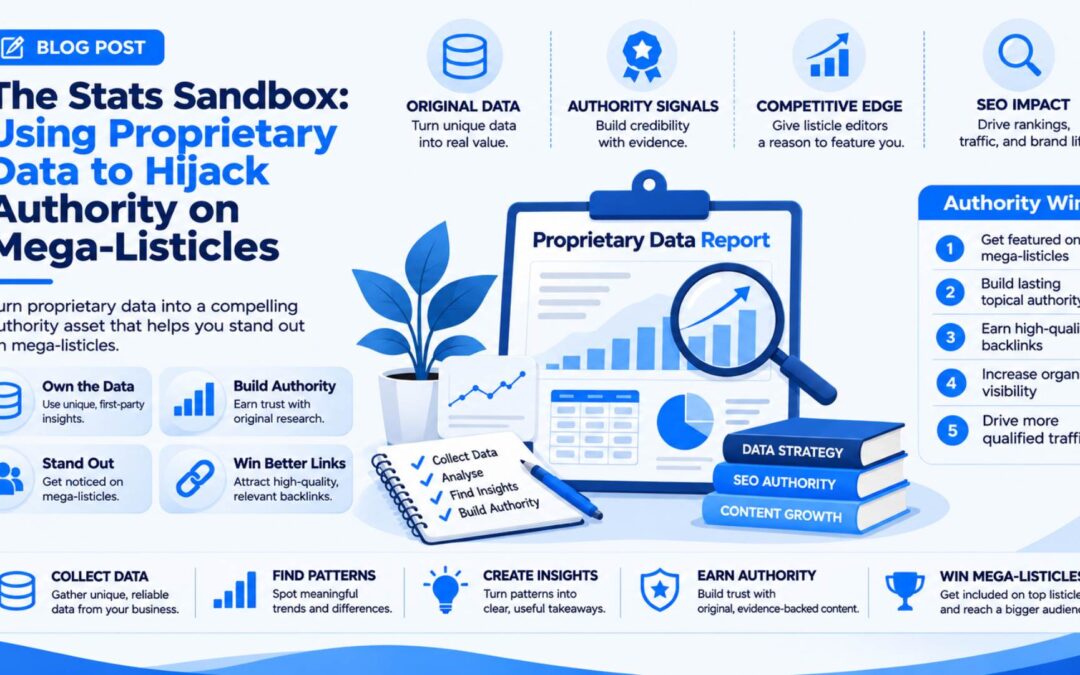
Mega-listicles have a weakness that most outreach ignores. The giant “50 Best Marketing Tools” or “The Ultimate Guide to Remote Work Software” articles all depend on the same thing to stay credible: numbers. Writers updating them need a current statistic for the introduction, a figure to define the category, and evidence for the trend claims they make. Most of the time, they end up recycling a three-year-old study that every competing article already cites.
That gap is your sandbox. If you own a fresh, well-documented dataset that answers a question these writers keep asking, you don’t need to beg for a place on the list. They come looking for you, because citing you makes their article better.
This guide is for content marketers, data analysts, and SaaS founders who want to earn authority on the biggest listicles in their category without relying on cold pitches. It covers three approaches that work together: building data magnets writers cite on their own, offering interactive tools they can embed, and reframing pitches as educational resources editors rarely turn down.
Quick Answer
How can proprietary data help you earn authority on mega-listicles?
Original research, useful statistics and free educational resources can help brands earn editorial citations and backlinks from high-authority listicles without relying on traditional link-building pitches.
Publish original data: Create fresh, well-documented statistics that writers can confidently cite.
Build data magnets: Answer specific industry questions with useful research and transparent methodology.
Offer interactive tools: Provide calculators, comparison widgets or charts that improve existing listicles.
Share educational resources: Suggest relevant guides, datasets and templates instead of promotional content.
Earn editorial authority: Focus on genuine value, natural backlinks and long-term credibility.
The Key Takeaway:
Make your content a resource that editors want to reference, rather than simply asking them to include your brand.
Why Data Works Where Pitches Fail
A standard listicle pitch asks an editor to do something for you. A data-led approach gives them something they already need.
Think about how a writer refreshes a mega-listicle. They update the title year, check that the tools still exist, revise pricing and then reach the introduction, which usually opens with a line such as “X% of teams now use project management software.” Their next step is a search for something like “project management software statistics”. Whoever owns the best answer to that search tends to get the citation.
This creates three advantages:
- Citations come with context. A writer referencing your data explains what you found, which positions your brand as a source of expertise rather than just another entry.
- The work compounds. One strong dataset can be cited by dozens of articles, including ones you never knew existed.
- It fits Google’s expectations. Links freely given because your content is useful are exactly the kind of editorial links search engines want to reward.
The aim isn’t to trick anyone. It’s to become the most useful source in your category, so that citing you is the obvious choice.
Part One: The “Zero-Pitch” Magnet
A zero-pitch magnet is original data writers find and cite without you ever emailing them. It works because it targets the questions listicle writers are already searching for.
What Makes Data Worth Citing
Not every number earns a link. The datasets writers reach for share a few traits:
- They answer a specific question. “How much do UK freelancers spend on software each month?” beats “The State of Freelancing”.
- They’re fresh. Writers prefer the most recent figure they can find, especially for articles with a year in the title.
- They’re quotable. A finding that fits in one sentence is far easier to cite than a complex chart.
- They’re transparent. A clear methodology tells writers the number is safe to repeat.
- They define something. Data that helps a writer explain what a category is, how big it is, or how it’s changing slots neatly into introductions and definition sections.
Three Sources of Proprietary Data
You probably have more citable data than you think. Most of it falls into one of three types.
1. Aggregated product data. If you run a SaaS product, your usage data can reveal patterns nobody else can see, such as the average number of integrations per account, the most common time of day for scheduling meetings or how long teams take to adopt a new feature. Always aggregate and anonymize it, and check that your privacy policy and customer agreements allow this kind of use. Under UK GDPR, the safest approach is to publish only figures that can’t identify any individual customer.
2. Micro-surveys. A focused survey of a few hundred people in a clearly defined group can produce findings that a broad industry report never captures. You don’t need a huge sample to be useful. You need a specific audience and honest reporting of who answered.
3. New analysis of public data. Government statistics, open datasets and public records are often underused because they’re hard to read. Combining or reanalyzing them to answer a practical question, and clearly crediting the original source, can create something genuinely new.
Building a Micro-Dataset Step by Step
- Find the question writers keep asking. Search for “[your category] statistics” and look at what the top-ranking pages cover. Then read the introductions of the biggest listicles in your space and note which statistics they cite and how old those figures are.
- Spot the stale or missing number. If every article cites the same study from several years ago, or makes a claim with no source at all, you’ve found your opening.
- Choose the right data source. Decide whether product data, a survey, or public data can answer the question most credibly.
- Collect only what you need. A tight dataset that answers one question well is more citable than a sprawling report.
- Analyze with care. Check for errors, avoid cherry-picking, and be cautious about claiming causes where you’ve only found correlations.
- Write findings as standalone sentences. Each key result should make sense on its own, so a writer can quote it directly.
Designing a Survey That Holds Up
A weak survey can damage your credibility instead of building it. A few basics make a big difference:
- Define the audience precisely, for example, “UK-based freelancers who invoice at least five clients a month”.
- Report your sample size, fieldwork dates, and how respondents were recruited.
- Avoid leading questions. “How much time does manual invoicing waste?” assumes the answer. “How long does invoicing take you each month?” doesn’t.
- Show the full question wording alongside each result.
- Be clear about limits. If your sample isn’t representative of a wider population, say so. Writers and editors respect honesty far more than inflated claims.
If you’re not confident with survey design, it’s worth involving someone with research experience or using an established panel provider.
Packaging Your Data for Citation
How you present the data matters as much as the data itself. Build a dedicated page that makes citing you effortless:
- One finding per heading, written as a clear statement, for example, “62% of UK freelancers use more than one invoicing tool”.
- A short, quotable summary at the top for writers in a hurry.
- Simple charts with the source and date included in the image itself, so the credit travels if the chart is shared.
- A methodology section covering sample, dates, recruitment, and question wording.
- A downloadable file, such as a CSV, for analysts who want to dig deeper.
- A clear last-updated date, plus a note on when the next update is planned.
- A suggested citation line and a clear license, such as Creative Commons Attribution, so writers know how they can use the material.
- Dataset structured data. Adding schema.org
Datasetmarkup can help search engines understand the page and may make it eligible for Google Dataset Search.
(The 62% figure above is illustrative. Publish only numbers your own data supports.)
Keeping the Magnet Working
A data page loses value as it ages. Plan an annual or biannual refresh, keep the URL the same, and add a short “what changed” note. Writers who cited your previous figure are more likely to update their link when they see a newer version at the same address.
Light seeding helps too. When you find a mega-listicle citing an outdated or unsourced figure that your data covers, a short note to the editor pointing out the fresher source is helpful rather than pushy. It’s the one email in this approach that resembles a pitch, and it’s framed entirely around improving their article.
Part Two: Trading Code for Context
Some of the most valuable listicle placements aren’t entries at all. They’re tools embedded inside someone else’s article. A pricing calculator in a “best accounting software” roundup, or a free template inside a “best project management tools” guide, gives readers something to use, and carries your brand into the heart of the page.
Why Editors Say Yes to Tools
Editors are under pressure to make their articles more useful than the competition. An interactive element helps them do that by:
- Giving readers a reason to stay on the page longer
- Helping readers make a decision, which is the whole point of a listicle
- Making the article stand out from near-identical competitors
- Requiring almost no extra writing on their part
Types of Embeddable Assets
The best assets stay neutral. A comparison widget that only recommends your own product won’t be accepted, and it shouldn’t be. A genuinely useful tool that happens to come from you is a very different proposition.
Building Tools Editors Trust
Editors are cautious about putting third-party code on their sites, and they’re right. Make yours easy to approve:
- Keep it lightweight so it doesn’t slow the page down.
- Make it responsive and accessible, with keyboard navigation, readable contrast, and clear labels.
- Avoid tracking scripts and data collection. An embed that quietly gathers reader information is a fast way to lose an editor’s trust and may create legal problems.
- Offer a simple embed method, usually an iframe or a short script, with clear installation instructions.
- Provide a non-JavaScript fallback, such as a static image with a link, for sites that restrict scripts.
- Allow light styling, so the tool can match the host site’s look.
Handling Attribution Links Properly
Embeds usually include a small credit line, such as “Calculator by Ledgerly”. This is where care matters.
Google’s spam policies specifically mention keyword-rich, hidden, or low-quality links embedded in widgets distributed across sites as an example of a link scheme. To stay on the right side of that:
- Use a short, visible, branded credit rather than a keyword-stuffed anchor.
- Never hide links in the embed code.
- Tell editors they’re free to make the credit link
nofollowor remove it entirely.
That last point may feel counterintuitive, but it builds trust. The real value is the editorial mention around the tool and the brand exposure to readers, not a link hidden in a code snippet.
Pitching a Tool: An Example
Using a fictional product:
Subject: A free calculator for your freelancer invoicing guide
Hi Sam,
Your guide to invoicing tools for UK freelancers is one of the most thorough I’ve read. The VAT section is especially clear.
We’ve built a free calculator that shows freelancers how close they are to the VAT registration threshold based on their monthly income. It might sit well under your VAT section, as it turns that explanation into something readers can act on.
It’s a lightweight embed with no tracking, it works on mobile and you’re welcome to style it, make the credit link nofollow or remove it. Here’s a preview link.
No problem at all if it isn’t a fit.
Maintaining Embedded Tools
Once your tool lives on other sites, you have a responsibility to keep it working:
- Monitor uptime and fix issues quickly.
- Never change what an embed does without telling the sites that host it. Swapping a neutral tool for a sales page is a breach of trust that editors don’t forget.
- Version your tools, so updates don’t break older embeds.
- Keep a list of host sites so you can contact editors if anything changes.
Part Three: The Resource Page Revival
Many editors are wary of requests to be added to a “best tools” list, but far more relaxed about suggestions for an educational resource. The difference is in what you’re asking them to endorse.
Why Resource Suggestions Rarely Get Rejected
When you pitch a product, the editor is being asked to recommend it. When you suggest a resource, such as a guide, dataset or free template, they’re being asked to help their readers learn something. That’s a much smaller commitment, and it aligns with why most resource sections exist in the first place.
Mega-listicles often include sections such as “Further reading”, “Helpful resources”, “How to choose” or “Getting started”. These sections are natural homes for genuinely educational material, and they’re often less crowded than the list itself.
Finding Resource Opportunities
- Look for “resources”, “further reading” or “useful links” sections within the listicles you already target.
- Search for standalone resource pages in your field using phrases such as “[topic] resources” or “[topic] useful links”.
- Check which resources these pages currently link to, and note any that are broken, outdated or behind a paywall.
- Look at guides and how-to sections inside mega-listicles, where an explainer or template could support the reader’s next step.
Turning a Product Pitch Into a Resource Suggestion
The shift is simple but powerful. Instead of “please add our tool to your list”, you offer “here’s a resource that helps your readers do what this article is about”.
What Makes a Resource Editors Accept
- It’s ungated. If readers must hand over an email address to access it, most editors will decline.
- It’s genuinely educational. A guide that teaches something useful, not a sales page with a few tips attached.
- It’s specific. “A step-by-step guide to registering for VAT as a UK freelancer” is far stronger than “Our freelancing hub”.
- It’s maintained. A clear update date shows the editor it won’t go stale.
- It’s balanced. Mentioning alternatives, including competitors where relevant, makes a resource more credible.
An Example Resource Suggestion
Subject: A resource for the “Getting started” section of your guide
Hi Sam,
I noticed the “Getting started” section of your freelancer invoicing guide links to a VAT explainer that now returns a 404 page.
In case it’s useful as a replacement, we publish a free, no-sign-up guide to VAT registration for freelancers. It’s updated each tax year and includes our recent survey data on how freelancers handle the threshold.
Happy to send anything else that would help. Thanks for keeping the guide so useful.
This combines two approaches from this guide: fixing a genuine problem on the page and offering an educational resource built on your own data.
Bringing the Three Approaches Together
These tactics are strongest when they support each other:
- Your data gives writers a reason to cite you in introductions and definitions.
- Your tools turn that data into something readers can use, inside the article itself.
- Your resources wrap the data and tools in educational content that fits naturally into resource sections.
A single well-researched dataset can feed all three: a statistics page, an embeddable chart or calculator, and a practical guide. That’s one research investment producing several routes into the same mega-listicles.
Scaling this work across many publishers and categories turns it into an ongoing editorial outreach program. Firms such as Megri Outreach approach this kind of asset-led work as part of sustained publisher relations, where the strength of the editorial case and the resource’s relevance carry more weight than outreach volume. Whichever route you take, the asset has to earn its place on merit.
Choosing Where to Start
If you’re starting from scratch, an educational resource built on a small, focused dataset is usually the fastest way to test the approach.
Accuracy and Ethics: Protecting Your Credibility
Data-led outreach only works while people trust your numbers. A few principles protect that trust:
- Never inflate or misrepresent findings to make them more quotable.
- Disclose your methodology fully, including limits and potential bias.
- Protect customer privacy. Publish only aggregated, anonymized figures and respect your privacy commitments.
- Credit original sources when you reanalyze public data.
- Correct errors openly. If you find a mistake, fix it, note the correction and tell sites that cited the wrong figure.
- Be careful with sensitive topics. Health, finance and legal statistics deserve extra checking before publication.
How to Measure Success
Track results across all three approaches:
- Citations and mentions, including unlinked references to your data
- Linking domains to your data, tool and resource pages
- Embeds in use, and the traffic they generate
- Referral traffic from listicles and resource pages
- Rankings for “[topic] statistics” and related queries
- AI visibility, by checking whether AI assistants cite your figures when asked about your category
Review these quarterly. Data assets often build momentum slowly before citations accelerate.
Common Mistakes to Avoid
- Publishing data nobody needs. Start with the questions writers are actually asking.
- Burying the key finding in a long PDF report.
- Hiding methodology, which makes careful writers reluctant to cite you.
- Gating resources behind forms.
- Stuffing keyword-rich links into widgets, which risks breaching Google’s guidelines.
- Letting data go stale, so newer studies replace your citations.
- Turning tools into sales pitches after they’ve been embedded.
FAQs
What is a zero-pitch data magnet?
A zero-pitch data magnet is an original dataset or survey that writers find and cite without being asked. It targets the statistics and definitions listicle writers search for when updating their articles, so citations come naturally rather than through outreach.
How large does a survey need to be to get cited?
There’s no fixed number, but a few hundred responses from a clearly defined audience can produce useful, citable findings. What matters most is reporting the sample size, audience, fieldwork dates, and question wording honestly, so writers can judge the data for themselves.
Can I use my customers’ product data for statistics?
Often, yes, provided you aggregate and anonymize it so no individual customer can be identified, and your privacy policy and customer agreements allow it. If you’re unsure, check with whoever handles data protection in your organization before publishing.
Are links in embeddable widgets against Google’s guidelines?
Not automatically. Google’s spam policies warn against keyword-rich, hidden or low-quality links distributed through widgets. A short, visible, branded credit is far safer, and letting host sites make the link nofollow or remove it removes the risk entirely.
Why do editors accept resource suggestions more readily than listicle pitches?
A resource suggestion asks the editor to point readers to useful information, not to endorse a product. If the resource is free, educational, specific and well maintained, it supports the article’s purpose, which makes it much easier to say yes to.
How often should I update a proprietary dataset?
Once a year suits most topics, and twice a year can make sense in fast-moving categories. Keep the same URL, add a clear update date and a short note on what changed, so existing citations can be refreshed easily.
Conclusion
Mega-listicles are hard to break into with a standard pitch, but they’re built on a constant need for fresh, trustworthy information. That need is your opportunity.Build focused datasets that answer the questions writers keep searching for, and package them so citing you takes seconds. Turn your data into tools editors are glad to embed, with clean code and honest attribution. And reframe your outreach around educational resources that help readers first. Do this consistently, and the biggest lists in your category stop being doors you have to knock on. They become places that cite you because their articles are better for it.