
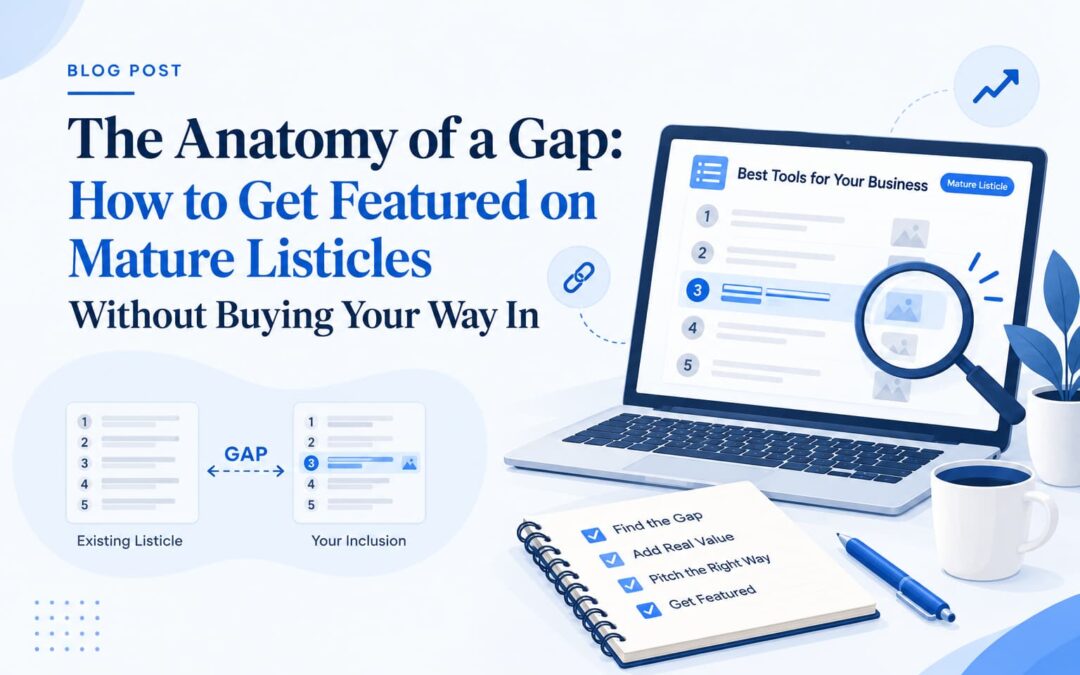
The Anatomy of a Gap: How to Get Featured on Mature Listicles Without Buying Your Way In
Every competitive software category has a handful of “Best [X] Tools” articles that seem to own the first page of Google. They have been there for years, they get refreshed every few months, and the same eight or ten names appear on almost all of them. If your product isn’t one of those names, it can feel as though the door is locked.
It isn’t locked. It’s just not opened by asking politely for a link, and it shouldn’t be opened with a cheque.
Mature listicles are maintained by editors who care about one thing above all: keeping the article accurate and useful enough to hold its ranking. That gives you an opening. When a list is missing a use case its readers clearly have, or still describes a tool as it existed two years ago, the editor has a problem. If you can show them that problem and hand them a clean solution, you stop being another person asking for a favour. You become the person who made their article better.
This guide explores how Listicle Link Building works through genuine editorial opportunities. It breaks down how to find content gaps, decide which lists deserve your effort, pitch the missing piece rather than the link, and maintain your placement once you’re included.
5 Key Takeaways
Find Genuine Content Gaps: Identify missing use cases, outdated information, and overlooked buyer needs in established listicles.
-
- Prioritise Relevant ListiclesEvaluate search rankings, audience fit, editorial credibility, and content gaps before outreach.
-
- Pitch Value, Not Links: Show editors how your product improves their article rather than simply requesting a backlink.
-
- Maintain Your PlacementKeep product information accurate, monitor updates, and build lasting editorial relationships.
- Measure Long Term Result Track placement success, referral traffic, AI visibility, and retention across article updates.
What Makes a Listicle “Mature”?
A mature listicle is an established comparison or recommendation article that has already earned its position. You’ll usually recognize it by a few traits:
- It ranks on page one for a commercial query such as “best project management software” or “top payroll tools for small businesses”.
- It has been live for a year or more and shows signs of regular updates, such as a refreshed date, a new year in the title or revised pricing.
- It attracts links from other sites, so its authority keeps compounding.
- It is often cited in AI-generated answers because comparison pages are a natural source for “which tool should I use?” questions.
These pages are valuable precisely because they’re hard to get into. Newer lists will take almost anyone. Mature listicle placements are harder to earn because established publishers have something to protect.
Why Paying for a Spot Is the Weaker Play
Many publishers will quote a fee for inclusion, and it’s tempting to treat that as a shortcut. Before you do, be clear about what you’re actually buying.
The link may be worth less than you think. Google’s spam policies treat links bought to influence rankings as link spam, and paid placements are expected to carry a rel="sponsored" or rel="nofollow" attribute. A properly disclosed paid placement may still bring referral traffic and visibility, but you shouldn’t rely on it for search value.
Pay-to-play lists lose credibility. When an article ranks whoever pays most, readers and editors notice. The lists that matter most tend to refuse to work this way.
Paid spots are temporary by design. Many paid inclusions expire at the next refresh unless you pay again. An earned placement that genuinely improves the article has a far better chance of surviving each update.
You learn nothing. Earning a placement forces you to understand where your product fits and why buyers should care. That knowledge pays off across your whole marketing effort.
This doesn’t mean sponsored placements have no place. It means they’re a different product, and you shouldn’t confuse them with earned editorial inclusion.
The Anatomy of a Gap
A gap is any point where a mature listicle no longer fully serves the reader it was written for. Understanding How to Get Featured in Listicles starts with identifying these opportunities and demonstrating how your product can address an unmet reader need. Most gaps fall into one of six types.
1. The Unaddressed Use Case
The list covers tools in general but ignores a specific need that a meaningful share of its readers clearly have. A “best CRM software” article might say nothing about CRMs for regulated industries, for non-profits managing donors, or for teams that sell mainly through WhatsApp. If your product genuinely serves that need, that’s the most persuasive gap you can fill.
2. Outdated Data
Software moves quickly, and lists fall behind. Look for:
- Prices that no longer match the vendor’s pricing page
- Free plans that have been removed, or new ones the list doesn’t mention
- Features described as “coming soon” that launched long ago
- Integrations or limits that have changed
Outdated data hurts the editor’s credibility, which makes it one of the easiest problems to raise.
3. Dead, Acquired or Renamed Tools
Products shut down, merge, or rebrand all the time. An entry pointing to a discontinued tool, or a company that’s been absorbed into a competitor, leaves a hole in the list and often a broken link. That hole needs filling, and editors usually welcome it.
4. The Missing Segment
Some lists quietly assume one type of buyer. They might be written entirely for large US teams, leaving out solo users, UK businesses that need VAT-ready invoicing, or companies with strict data residency requirements. If the article’s own search query attracts those readers, the gap is real.
5. The Missing Comparison Angle
Readers often want to know how tools differ on a specific factor, such as onboarding time, offline access, accessibility, or AI features. If competing articles and AI answers all address that factor and this list doesn’t, there’s an angle worth pitching.
6. Structural Decay
Sometimes the gap isn’t one entry but the whole article: a year in the title that doesn’t match the content, screenshots of interfaces that no longer exist, or a methodology section that was never written. You can’t fix all of that from outside, but pointing out one clear issue alongside your suggestion shows you’ve read the piece properly.
How to Find Gaps: A Practical Audit
Key Areas to Examine During Your Audit
Finding a gap takes about twenty to forty minutes per article
once you’ve done it a few times. Here’s a process that works.
Ask yourself what you’d still need to know after finishing it.
Unanswered questions are gaps.
Open each vendor’s pricing and features pages.
Note anything the list gets wrong or leaves out.
Look at related searches and “People also ask” questions
for the article’s main query. Questions the article
doesn’t answer point to missing use cases.
If three of the top five articles cover a use case
and this one doesn’t, the editor is falling behind
their own competition.
Ask a couple of AI assistants the same question the
listicle targets. Notice which needs, tools or criteria
appear in their answers but not in the article.
Only pursue gaps your product genuinely fills.
If you’d be a weak entry for that use case,
the editor will see it, and you’ll have burned
the relationship for nothing.
Pitch the Missing Feature, Not the Link
The difference between pitches that work and pitches that get ignored usually comes down to one question: who is the email about?
A weak pitch is about you. It introduces your company, lists your features, and asks to be added, ideally with a link. Editors receive these constantly, and most go unanswered.
A strong pitch is about the article and its readers. It identifies a specific gap, explains why it matters to readers, and offers a ready-made way to close it. Your product is part of the solution, but it isn’t the headline.
What a Strong Pitch Includes
- A specific subject line. Reference the article and the gap, for example: “Your CRM roundup: a gap for teams selling through WhatsApp”.
- One sentence of genuine context. Show you’ve read the piece. Mention a section, a claim or a recent update.
- The gap, stated plainly. Name the use case or outdated detail, and explain who it affects.
- Evidence. A link to the vendor’s current pricing page, a changelog entry, or a short note on how many related questions appear in search.
- A ready-to-use entry. Write a short, balanced description of your product in the same style and length as the existing entries. Include who it’s best for, its main limitation, and current pricing.
- No demands. Leave the link, anchor text, and placement to the editor. If they include you, the link usually follows naturally.
An Example Pitch
Here’s how that looks in practice, using a fictional product:
Subject: Your CRM roundup: a gap for teams selling through WhatsApp
Hi Natasha,
I read your updated guide to CRM software for small businesses. The section comparing pipeline views is genuinely useful.
One thing I noticed: none of the tools listed handle sales conversations that happen mainly in WhatsApp, which is how a lot of small retailers in the UK, India and Latin America sell. It’s also one of the related questions that comes up for your main search term.
I work at Chatline CRM, which is built for that use case. In case it’s helpful, I’ve drafted an entry in the same format as the others below, including where it falls short. It’s free for up to three users and £12 per user after that.
Separately, the pricing for one of the other tools in the list changed in March. Their current pricing page is here if you’d like to check.
Happy to answer any questions. Thanks for keeping the guide up to date.
Notice that the pitch flags a second, unrelated issue at no benefit to the sender. That small act of help tells the editor you’re useful, not just interested.
What to Avoid
- Mass templates with the editor’s name swapped in
- Asking for a specific position, such as “number one”
- Offering money or link swaps in a first email
- Criticizing competitors listed in the article
- Following up more than twice
Build a Scorecard Before You Pitch
Manual outreach takes time, so it pays to know which lists deserve it. Effective Listicle Link Building Strategies involve evaluating search relevance, editorial credibility, audience fit, and the strength of each content gap before contacting publishers. A simple scorecard stops you spending an afternoon on an article that was never going to move the needle.
Score each listicle from 1 to 5 on the criteria below, multiply by the weight, and add up the total out of 100.
| Criterion | What to Check | Weight |
|---|---|---|
| Search intent match | Does the article’s main query match how your buyers search? | 20 |
| Ranking strength | Current position, plus whether it’s stable or slipping | 15 |
| Gap strength | How clear and relevant is the gap you’ve found? | 20 |
| Update cadence | Has it been updated in the past six to twelve months? | 10 |
| Editorial independence | Does it seem to rank on merit rather than payment or affiliate commission alone? | 10 |
| Editor reachability | Is there a named author or editor you can contact? | 10 |
| Audience fit | Do the readers resemble your customers in size, region and need? | 10 |
| AI visibility | Is the page cited in AI-generated answers for the query? | 5 |
How to Read Your Score
- 80 and above: A priority target. Invest in a fully tailored pitch.
- 60 to 79: Worth pursuing, but keep the pitch efficient.
- Below 60: Park it. Revisit if the article is updated or the ranking improves.
Treat these weights as a starting point, not a formula. A SaaS company chasing enterprise buyers might weight audience fit more heavily, while a new product might care most about gap strength. What matters is that you score every list the same way, so you can compare them fairly.
Red Flags That Override the Score
Some signals justify skipping a list regardless of its total:
- Every entry links out with an affiliate tag and nothing else explains the rankings
- The page shows signs of being a link farm, such as unrelated topics, thin content and heavy outbound linking
- The publisher openly sells list positions without disclosure
- The article has dropped sharply in rankings and shows no sign of recovery
Keeping Your Spot When the List Keeps Changing
Getting in is the first half of the job. Mature listicles are often refreshed several times a year, and every refresh is a moment where entries can be cut, reordered or rewritten. The brands that stay on these lists usually do a few simple things consistently.
Monitor the Page
Set up a page change alert or check the article monthly. Track its ranking for the main query too. You want to know about a refresh before it happens, or at least the day it goes live.
Be the Easiest Entry to Keep
Editors updating a long article want accurate information fast. Make that easy:
- Keep a single, public page with your current pricing, plans and key features.
- Email the editor briefly when something material changes, such as a price, a new plan or a major feature.
- Offer an updated screenshot or a fresh data point before you expect a refresh.
The goal is to make keeping your entry accurate take the editor less effort than anyone else’s.
Keep Earning the Place
An entry survives refreshes when it still deserves to be there. If your product drifts away from the use case that got you in, or a competitor serves it better, expect to be replaced. Monitoring customer feedback on that use case helps protect your placement.
Treat the Editor as a Long-Term Contact
Send useful things that have nothing to do with your entry: a broken link elsewhere in the article, a new tool worth reviewing, a data source they might like. Over time, you become someone people open emails from.
Handle Removal Gracefully
If you’re dropped, ask once, politely, whether there’s anything that would make you a better fit next time. Then note the answer and move on. A calm response leaves the door open for the next update.
Scaling Gap-Based Outreach
Working through a handful of lists is manageable in-house. However, identifying Editorial Backlink Opportunities across dozens of established listicles requires consistent research, careful record-keeping, and relationships that last beyond a single pitch. As outreach expands across several categories, it becomes a sustained editorial programme rather than a series of individual requests.
Specialist outreach firms such as Megri Outreach treat listicle inclusion as an extension of publisher relations, prioritizing editorial fit and verifiable placement detail over the volume-led acquisition of backlinks. Whether you build this capability yourself or bring in outside support, the principles in this guide stay the same: find a genuine gap, lead with the reader’s benefit, and keep earning the place.
How to Measure Whether It’s Working
Links are only one signal. Measuring AI visibility alongside referral traffic, brand awareness, and placement retention provides a broader picture of your outreach results. Track the following outcomes:
- Pitch acceptance rate: How many targeted lists added you, and which gap types worked best
- Referral traffic: Visits from each listicle, and how those visitors behave on your site
- Placement survival: How many entries remain after each refresh
- Branded search: Whether more people search for your product name over time
- AI visibility: Whether your product starts appearing in AI answers for the list’s core queries
Review these quarterly. Analysing the results helps refine your Listicle Outreach Strategies by revealing which categories, content gaps, and pitch angles generate the strongest editorial responses and lasting placements.
Common Mistakes to Avoid
- Pitching lists where you don’t belong. Relevance is the whole argument. Without it, there’s nothing to pitch.
- Leading with the link. It signals that you care about SEO more than the article.
- Overselling. Entries that read like ad copy get rewritten or cut. Include an honest limitation.
- Ignoring the update cycle. Pitching a week after a refresh often means waiting months for the next one.
- Letting your details go stale. An outdated entry is the first thing an editor removes.
Frequently Asked Questions
Conclusion
Mature listicles aren’t closed. They’re maintained by editors who need help keeping them accurate, and that need is your way in. Find the use case the list overlooks or the detail it has let go stale, show the editor exactly how to fix it, and make your product part of a better article rather than the point of your email.
Use a scorecard to spend your time on lists that matter, and once you’re included, make yourself the easiest entry to keep. Done consistently, this approach builds placements that hold their value through every refresh, along with editorial relationships that keep paying off long after the first pitch lands.