
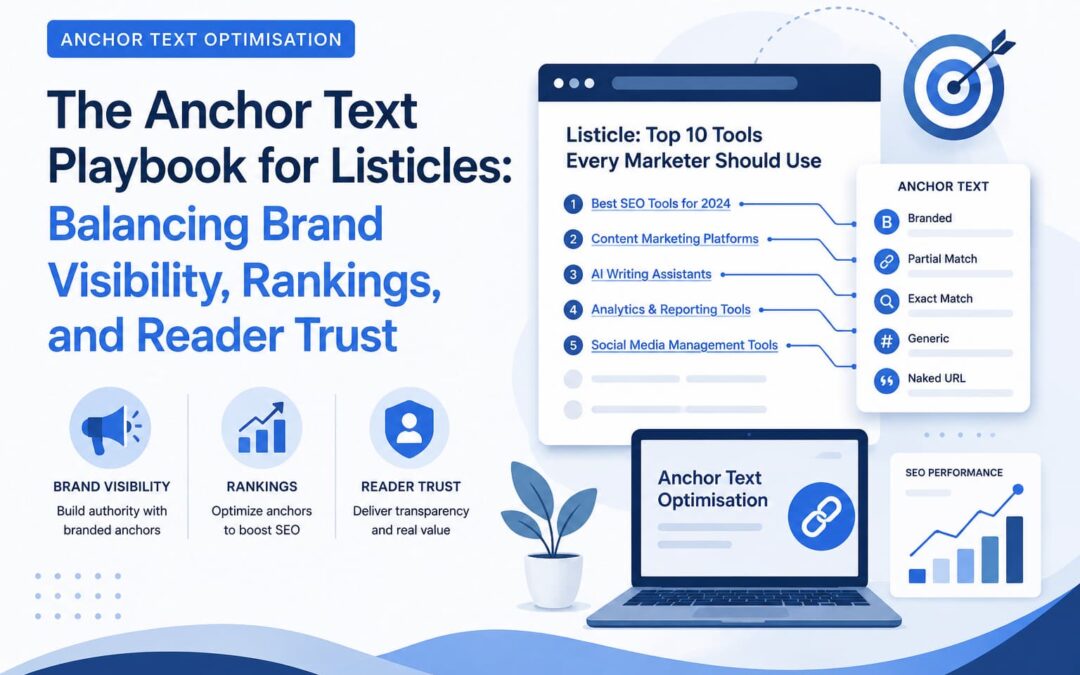
The Anchor Text Playbook for Listicles: Balancing Brand Visibility, Rankings, and Reader Trust
Anchor text can make or break a listicle placement. Get the ratio wrong, and you risk a Google penalty; get it right, and you build rankings, brand visibility, and reader trust all at once. This playbook breaks down the exact anchor text distribution used by top-performing listicles in 2026, from branded and partial-match anchors to the exact-match ratios that trigger algorithmic suppression. Includes a practical checklist, real examples, and FAQs to build lasting topical authority.
TL;DR: Anchor Text Optimization in 60 Seconds
- Anchor text is the clickable words in a link, and it signals topical relevance to search engines.
- Listicles are high-value anchor text real estate because they’re often well-linked, frequently updated, and trusted by readers comparing options.
- A safe anchor profile mixes branded (30–40%), partial match (10–20%), generic (15–25%), naked URL (10–20%), exact match (1–5%), and image alt text (5–10%).
- Exact match anchors carry the highest reward but also the highest risk; overuse has historically triggered Penguin-style penalties.
- Google now reads the sentence around a link almost as closely as the anchor itself, so context matters as much as keyword choice.
- The safest long-term strategy is diversity, quarterly audits, and anchors that genuinely match what the reader will find on the other side of the click.
Table of Contents
- What Is Anchor Text Optimization? (Quick Definition)
- TL;DR: Anchor Text Optimization in 60 Seconds
- Why Anchor Text Matters in Listicle Placements
- Ideal Anchor Text Distribution: The 2026 Ratio Table
- The 6 Types of Anchor Text, Explained
- What Happens If You Over-Optimize Anchor Text? (Risks & Google Penalties)
- How to Choose the Right Anchor Text for a Listicle Placement (Step-by-Step)
- Anchor Text Best Practices Checklist
- Real Example: Anchor Text in a “Top 10 SEO Tools” Listicle
- Anchor Text vs. Contextual Relevance: What Matters More in 2026?
- FAQs: Anchor Text Optimization for Listicles
- Key Takeaways / Final Checklist
1. What Is Anchor Text Optimization? (Quick Definition)
Anchor text is the visible, clickable words in a hyperlink. Anchor text optimisation is the practice of deliberately choosing words so that a link conveys the right meaning to search engines whilst still feeling natural to the person reading it.
In listicle placements, such as a “Top 10 Tools for SEO” article, anchor text is doing double duty. It tells Google what the destination page is about, and it tells the reader whether the link is worth clicking. Get the balance wrong, and you either confuse the algorithm or annoy the reader. Get it right, and the link works quietly in the background, building authority without drawing attention to itself.
2. TL;DR: Anchor Text Optimization in 60 Seconds
- Anchor text is the clickable words in a link, and it signals topical relevance to search engines.
- Listicles are high-value anchor text real estate because they’re often well-linked, frequently updated, and trusted by readers comparing options.
- A safe anchor profile mixes branded (30–40%), partial match (10–20%), generic (15–25%), naked URL (10–20%), exact match (1–5%), and image alt text (5–10%).
- Exact-match anchors carry the highest reward but also the highest risk; their overuse has historically triggered Penguin-style penalties.
- Google now reads the sentence around a link almost as closely as the anchor itself, so context matters as much as keyword choice.
- The safest long-term strategy is diversity, quarterly audits, and anchors that genuinely match what the reader will find on the other side of the click.
3. Why Anchor Text Matters in Listicle Placements
Listicles behave differently from standard blog posts. A “Best of” or “Top 10” format is built around comparison, which means every link is doing a specific job: it’s vouching for one option among several. That context gives anchor text unusual weight.
Contextual relevance. Google’s ranking systems weigh the surrounding text of a link almost as heavily as the anchor text itself. A link sitting inside a well-written, specific description of what a tool or service does will carry more signal than the same anchor dropped into a generic sentence.
User expectations. Readers scanning a listicle are making quick decisions. If an anchor says “free SEO audit tool” and the destination page is a pricing page, that mismatch immediately costs trust, and readers notice faster than algorithms do.
Ranking signals over time. A listicle that ranks well tends to stay live for years, is updated, and is often referenced by other sites. That longevity means the anchor text choices made today continue to send signals long after the piece is published, so it’s worth getting them right the first time rather than fixing them later.
4. Ideal Anchor Text Distribution: The 2026 Ratio Table
There’s no single “correct” ratio that suits every site, but the table below reflects what tends to hold up across most well-audited link profiles in 2026.
| Anchor Type | Example | Safe Ratio | Risk if Overused |
|---|---|---|---|
| Branded | “Megrisoft” | 30–40% | Very low |
| Partial Match | “AI SEO services” | 10–20% | Low to medium |
| Generic | “click here”, “learn more” | 15–25% | Very low |
| Naked URL | “https://megrisoft.com” | 10–20% | Very low |
| Exact Match | “anchor text optimisation” | 1–5% | High (Penguin-style penalty risk) |
| Image Alt | alt=”SEO tools” | 5–10% | Low |
Branded anchors should carry the largest share because that’s how a natural link profile actually looks; most people linking to a brand simply use its name. Exact match anchors deserve the smallest share and the most caution, since a spike in identical keyword-rich anchors is one of the clearest fingerprints of manipulated linking.
5. The 6 Types of Anchor Text, Explained
Branded. The company or product name used as the anchor, such as “Megrisoft.” This is the safest anchor type and should form the backbone of any listicle mention.
Partial match. A phrase that includes a keyword alongside other descriptive words, such as “SEO outreach services.” It signals relevance without looking manufactured.
Generic. Anchors like “learn more” or “click here” that carry no keyword value but read naturally and reduce the density of anything more targeted.
Naked URL. The web address itself is used as the anchor text, for example, “https://megrisoft.com”. Common in citation-style listicles and roundups, and it looks entirely organic.
Exact match. The anchor matches the target keyword word-for-word, such as “anchor text optimisation.” Powerful for rankings when used sparingly, but the single riskiest anchor type when overused.
Image alt text. When a listicle uses a logo, screenshot, or product image as the link, the alt attribute serves as anchor text for accessibility tools and search engines alike and should be treated with the same care as visible anchors.
6. What Happens If You Over-Optimize Anchor Text? (Risks & Google Penalties)
Over-optimisation. A cluster of exact-match, keyword-heavy anchors across multiple listicles is one of the oldest patterns Google’s algorithms have been trained to catch. It doesn’t take many before a profile starts looking engineered rather than earned.
Velocity issues. Dozens of keyword-rich links appearing across guest posts and listicles within a short window look unnatural, even if each individual link would be fine on its own. Natural link building tends to be gradual and uneven, not a sudden spike.
Copying competitor ratios blindly. Studying competitor anchor profiles is useful, but copying their ratios without understanding why those ratios exist for their specific brand and history can backfire. A ratio that suits an established brand with years of organic mentions won’t necessarily suit a newer site.
7. How to Choose the Right Anchor Text for a Listicle Placement (Step-by-Step)
Step 1: Identify the listicle’s intent. Is it a comparison piece, a roundup, or a “best tools” resource? This shapes whether a branded or partial-match anchor fits better.
Step 2: Match the anchor to the promise of that specific list item. If the entry says “best for agencies managing multiple clients,” the anchor should reflect that angle rather than a generic keyword.
Step 3: Check your existing anchor mix before adding another link. A quick audit of recent placements prevents accidental over-pushing of any anchor type beyond its safe ratio.
Step 4: Write the anchor into a sentence, not just a link. Google reads the surrounding text, so the anchor should sit inside a specific, useful sentence rather than a vague one-liner.
Step 5: Vary anchor text across multiple listicle placements. Using the exact same anchor across ten different articles is a red flag; slight, natural variation is far safer.
Step 6: Treat image alt text as a genuine opportunity, not an afterthought. If the listicle includes a screenshot or logo, write descriptive alt text rather than leaving it blank or keyword-stuffing it.
8. Anchor Text Best Practices Checklist
- Diversify anchor types across every listicle placement rather than using a single formula.
- Audit anchor ratios quarterly to catch drift before it becomes a pattern.
- Match anchor intent to the actual content on the landing page, not just the keyword you want to rank for.
- Use alt text on linked images as a legitimate anchor opportunity.
- Study top-ranking listicles in your niche for natural anchor patterns, but adapt rather than copy.
- Keep exact match anchors under 5% of your total profile.
- Favour branded and partial match anchors as your default choice unless there’s a specific reason to do otherwise.
9. Real Example: Anchor Text in a “Top 10 SEO Tools” Listicle
Take a listicle titled “Top 10 SEO Tools for Agencies.” A well-balanced entry for a fictional brand might use:
- A branded anchor such as “Megrisoft SEO Suite” for the primary mention.
- A partial match anchor such as “best outreach software for agencies” further down the same paragraph.
- A generic anchor such as “learn more” on a secondary reference within the same entry.
- An exact-match anchor, such as “anchor text optimisation tool,” is used once, if at all, and only where it genuinely fits the sentence.
This mix reads naturally to humans, reflects how people actually link in practice, and avoids placing all the ranking weight on a single, risky anchor type.
10. Anchor Text vs. Contextual Relevance: What Matters More in 2026?
Anchor text and contextual relevance aren’t competing factors; they work together, but their relative weight has shifted. A decade ago, exact-match anchors had enormous influence on their own. Today, Google’s systems are far better at reading the paragraph around a link, meaning a well-written, specific sentence can compensate for a more generic anchor.
That said, anchor text still matters. It remains the clearest, most direct keyword signal a page can receive from an external link. The practical takeaway is that anchor text sets the direction, and surrounding context confirms it. Neither replaces the other; the safest and most effective listicle placements do both well.
11. FAQs: Anchor Text Optimization for Listicles
What is the safest anchor text ratio for listicles in 2026? A safe starting point is roughly 30–40% branded, 10–20% partial match, 15–25% generic, 10–20% naked URL, 5–10% image alt, and under 5% exact match.
Can too much exact-match anchor text get a page penalised? Yes. A high concentration of exact-match anchors across listicles and guest posts is one of the clearest patterns associated with algorithmic suppression, historically linked to Google’s Penguin updates.
Does anchor text still matter if the surrounding content is well written? Yes, but its weight is now shared with context. Strong surrounding text improves the value of an anchor rather than replacing the need for a sensible anchor choice.
Should every link in a listicle use a different anchor? Not necessarily every single one, but variation across multiple placements is important. Using the identical anchor repeatedly across many listicles looks manufactured rather than organic.
Is image alt text really counted as anchor text? Yes, when an image is used as the clickable element, its alt attribute functions as anchor text for both accessibility tools and search engines, so it deserves the same care as visible text links.
How often should anchor text profiles be audited? A quarterly review is generally enough to catch drift early, particularly for sites running ongoing outreach or guest posting campaigns.
12. Key Takeaways / Final Checklist
Anchor text optimisation isn’t a one-off task; it’s an ongoing discipline that rewards patience over shortcuts. The brands that get the most long-term value from listicle placements are rarely the ones chasing exact-match anchors as hard as possible. They’re the ones treating every link as part of a bigger, more natural pattern that builds up over months and years.
If you take one thing forward from this playbook, let it be this: audit before you add. Before your next listicle placement goes live, check your current anchor mix against the ratio table in Section 4. If branded and partial match anchors are already carrying the weight, you have room to be more generous with a keyword-rich anchor. If an exact match is creeping past 5%, pull back and lean on a generic or naked URL anchor instead.
Before you publish your next listicle placement, run through this:
- Pull your last 10–15 anchor text placements and map them against the safe ratio table.
- Flag any exact match anchor appearing more than once across recent placements.
- Rewrite one generic anchor into a more descriptive partial match, and one partial match into a branded anchor, to rebalance naturally.
- Check that every anchor still matches the actual content on its landing page.
- Set a recurring quarterly reminder to repeat this audit, rather than waiting until rankings dip to notice a problem.
Treat this checklist as a habit rather than a one-time fix, and your anchor profile will stay healthy long after any single listicle placement has been forgotten by the algorithm.
Want Your Brand Featured in High-Authority Listicles — The Right Way?
Getting anchor text ratios right across dozens of listicle placements takes more than good intentions; it takes constant auditing, relationship-driven outreach, and a genuine understanding of which publishers actually move the needle for your niche.
Megri Outreach listicle outreach and link-building team handles the entire process for you — from identifying high-authority “Top 10” and “Best of” roundups in your industry, to securing genuine editorial placements, to crafting anchor text profiles that stay firmly on the safe side of Google’s guidelines.
No spammy mass outreach. No risky exact-match stuffing. Just strategic placements built to boost rankings, brand visibility, and reader trust — sustainably, month after month.
👉 Get in touch with Megri Outreach today for a free anchor text and backlink profile audit, and see exactly where your listicle placements stand.