
Most content managers can tell within a second whether an email was written for them. The giveaway is rarely the greeting. It’s the sentence after it, the one that praises “your amazing blog” without naming a single article, or asks to be added to “your resource page” on a site that doesn’t have one.
That kind of message is the product of shotgun outreach: one template, a scraped list of thousands of addresses and the hope that volume makes up for relevance. It used to produce a trickle of links. Today it mostly produces spam complaints, damaged sending domains and a reputation that arrives before your next email does.
The alternative isn’t to write every email by hand from scratch. That doesn’t scale. The alternative is to build outreach sequences where the research does the heavy lifting, custom variables carry that research into every message, and relationships start well before the first pitch. This guide shows you how to make that shift, step by step.
What Shotgun Outreach Actually Looks Like
Shotgun outreach is easy to recognise once you know the pattern:
- Lists built from scraped contact pages or bought databases
- One template sent to everyone, with only
{{first_name}}and{{website}}changing - Generic compliments that could apply to any site on the internet
- A link request in the first email, often with a fee or link swap attached
- Automated follow-ups that keep coming regardless of relevance
The appeal is obvious. It feels productive. You can send a thousand emails before lunch. The trouble is that the costs are delayed and spread out, so they’re easy to ignore until they’re expensive to fix.
Why Shotgun Outreach Destroys Brand Reputation
Editors Talk to Each Other
Content managers share screenshots of bad pitches in private groups, newsletters and community channels. A brand name attached to a lazy template becomes a running joke surprisingly quickly. Once that happens, even your genuinely relevant emails start from a deficit.
Your Domain Gets Remembered for the Wrong Reasons
Mailbox providers track how recipients respond to your messages. When people mark emails as spam, ignore them en masse or never open them, the reputation of your sending domain drops. Future emails, including the good ones, get filtered into spam folders or blocked entirely.
Gmail and Yahoo tightened their sender requirements in 2024. Bulk senders now need proper email authentication and must keep reported spam rates low; Google’s guidance sets a hard ceiling of 0.3% and recommends staying below 0.1%. Cold outreach that triggers complaints can push a domain past those limits fast.
You Train Your Market to Ignore You
Every irrelevant email teaches a recipient that your name means noise. The editor who deletes your shotgun pitch today is the same person you’ll want to reach next quarter with something genuinely useful.
It Puts Your Main Business Email at Risk
If outreach goes out from the same domain your sales team, invoices and customer support use, a damaged reputation affects all of it. That’s the most expensive mistake on this list, and it’s entirely avoidable.
How to Avoid Burning Your Email Domains
Protecting deliverability is the foundation everything else rests on. None of the personalisation below matters if your emails never reach an inbox.
Use a Separate Sending Domain
Send outreach from a closely related secondary domain, such as getyourbrand.com alongside yourbrand.com, rather than your primary one. Make sure it clearly belongs to your brand, with a simple website that explains who you are. A secondary domain isn’t a licence to send junk; it’s insurance that keeps a mistake from spreading to your core business email.
Authenticate Everything
Set up all three standard authentication records:
- SPF confirms which servers are allowed to send email for your domain.
- DKIM adds a digital signature that proves the message wasn’t altered.
- DMARC tells mailbox providers what to do with messages that fail those checks, and gives you reports.
Your email provider’s help documentation will walk you through each one. It’s usually a short job, and skipping it is one of the fastest ways to land in spam.
Warm Up New Mailboxes Gradually
A brand-new mailbox that suddenly sends hundreds of messages looks suspicious. Start with a small number of emails per day and increase slowly over several weeks. Keep daily volumes per mailbox modest even after warm-up, especially for cold outreach.
Keep Your List Clean
- Verify email addresses before sending, so bounces stay low.
- Remove anyone who asks to stop, immediately and permanently.
- Never buy lists or scrape addresses you have no legitimate reason to contact.
Watch the Signals
Monitor bounce rates, reply rates and spam complaints for every campaign. If you send meaningful volume to Gmail users, Google Postmaster Tools shows how your domain’s reputation is trending. A sudden drop in replies or opens is often the first sign something has gone wrong.
Respect the Rules
Cold B2B outreach is legal in many places when it’s relevant and easy to opt out of, but the rules vary. In the UK, PECR and UK GDPR apply; in the US, CAN-SPAM sets requirements; and individual sole traders may be treated differently from company addresses. Always identify yourself honestly, explain why you’re writing and include a clear way to opt out. If in doubt, take advice for the markets you contact.
From Blasts to Sequences: A Different Way to Think
A sequence isn’t simply a template with follow-ups attached. It’s a short, planned conversation with one specific person about one specific reason to talk.
The most useful mindset shift is to tier your prospects by value and effort:
Three Tiers of Outreach Personalisation
Who They Are
High-value publications and editors you’ve researched deeply
ApproachFully hand-written emails, often after community contact
Who They Are
Relevant, well-qualified prospects
ApproachResearch-led templates powered by custom variables
Who They Are
Weak or uncertain fit
ApproachDon’t send yet. Research more or drop them
That third tier matters more than it seems. The biggest gains in outreach often come from deciding who not to email.
Custom Variables: The Engine of Personalisation at Scale
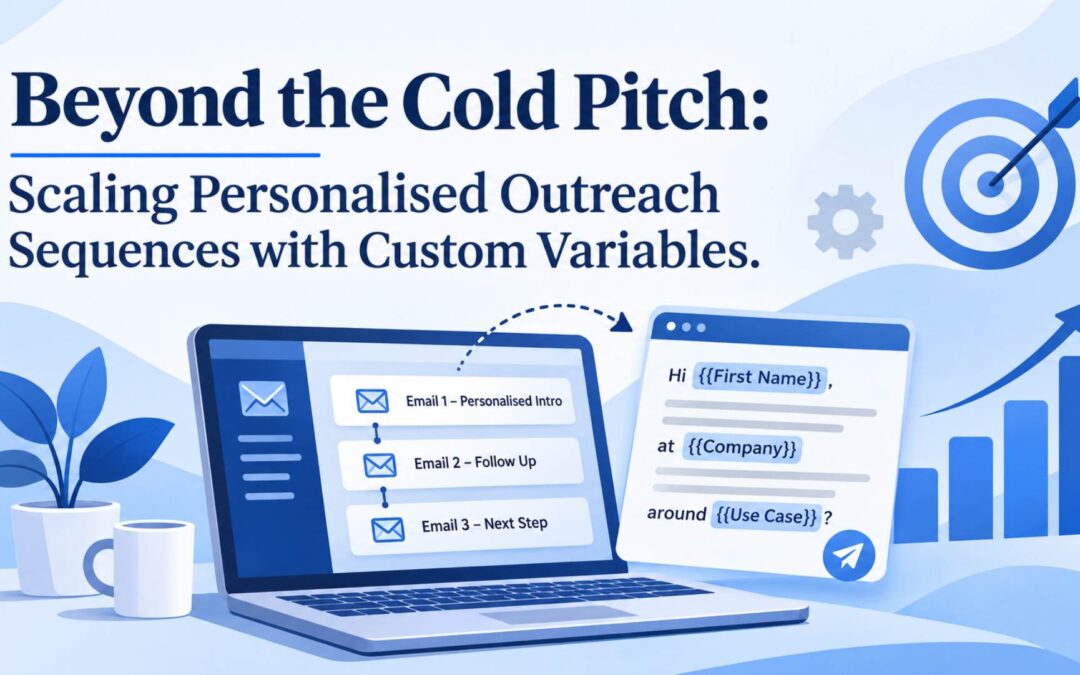
Most modern outreach tools let you add custom fields to each prospect and insert them into templates. The syntax differs between tools, but it usually looks something like {{Field_Name}}. Most teams stop at first name and website. That’s where the real opportunity is being wasted.
The principle is simple: a custom variable should carry a piece of research, not just a piece of data. A first name is data. The specific gap you found in someone’s article is research. Research is what makes an email feel written for one person.
Variables Worth Building
| Variable | What It Holds | Example Value |
|---|---|---|
{{Editor_Name}} |
The person responsible for the page | Priya |
{{URL_Title}} |
The exact title of the article you’re referencing | The 12 Best Invoicing Tools for Freelancers |
{{URL}} |
The page itself | Full article URL |
{{Last_Updated}} |
When the page was last refreshed | March |
{{Gap_Type}} |
The category of problem you found | outdated pricing |
{{Gap_Detail}} |
The specific issue, in one plain sentence | two of the tools listed no longer offer a free plan |
{{Gap_Incentive}} |
What the editor gains by acting | a quick fix before your next refresh, plus a ready-to-paste entry for VAT-ready invoicing |
{{Shared_Context}} |
A genuine connection point | we chatted in the content marketing Slack about refresh schedules |
{{Relevant_Asset}} |
Something useful you can offer | our comparison of UK invoicing rules for sole traders |
Why URL_Title and Gap Incentives Matter Most
{{URL_Title}} proves you’ve actually looked at the page. Quoting an article’s real title, correctly, instantly separates you from scraped templates that say “your recent post”.
{{Gap_Incentive}} answers the question every editor silently asks: what’s in it for me? Rather than asking for something, the email leads with a benefit. That might be a correction, a missing use case, fresh data or a useful asset. When the incentive is specific, the request almost takes care of itself.
Filling Variables: A Research Workflow
- Build the prospect list from relevance first. Start with articles that rank for your topic, not with a database of contacts.
- Open every page. Record the exact title, the date it was last updated and the person responsible for it.
- Find the gap. Look for outdated details, missing use cases or broken links. Write the gap as one plain sentence.
- Define the incentive. Ask what would genuinely make this article better, and what you can hand over to help.
- Add shared context where it’s real. Note any genuine connection, such as a community conversation or a mutual contact. Never invent one.
- Score the prospect. If you can’t fill the gap and incentive fields with something specific, the prospect isn’t ready. Move it to Tier 3.
A simple spreadsheet with one column per variable works well. Most outreach tools can import it directly.
Writing Templates That Survive Real Data
A variable-driven template has one job: to read naturally for every single row. Here’s an example first email:
Subject: Quick fix for {{URL_Title}}
Hi {{Editor_Name}},
I was reading {{URL_Title}} after your {{Last_Updated}} update and noticed {{Gap_Detail}}.
I thought it might be worth flagging, as it’s {{Gap_Incentive}}.
Happy to send over anything that would help. No worries at all if the timing isn’t right.
To make templates like this hold up at scale:
- Write each variable as a complete phrase, so it slots into the sentence without awkward grammar.
- Set fallbacks for optional fields. If
{{Shared_Context}}is empty, the sentence that uses it should disappear rather than break. - Preview five random rows before launching. Read them aloud. If any sound robotic, rewrite the template or the data.
- Watch capitalisation and punctuation. A lowercase title or a double full stop is a giveaway.
- Keep links to a minimum in the first email. One relevant link at most is a sensible rule for deliverability and readability.
Designing the Follow-Up Sequence
A good sequence is short and every message earns its place. A typical structure:
- Email one: The gap and the incentive. No direct link request.
- Email two, about five to seven days later: Add something new, such as the ready-to-paste entry or the
{{Relevant_Asset}}. Never just “bumping this up”. - Email three, about a week after that: A brief, friendly close that leaves the door open for the next update.
Stop the sequence the moment someone replies, including an out-of-office that names a colleague. Then continue the conversation by hand.
Build the Relationship Before the Ask: Slack and Discord Communities
The warmest outreach doesn’t feel like outreach at all. It’s a continuation of a conversation that started somewhere else. Professional Slack and Discord communities are one of the best places for that conversation to begin.
Why Communities Work
Content managers, SEO leads and editors use these spaces to swap advice, ask for tools, vent about workloads and share opportunities. They’re there to learn and help, not to receive pitches. If you show up in the same spirit, people start to recognise your name for the right reasons.
Finding the Right Communities
Look for groups where the people who manage your target pages actually spend time:
- Content marketing and editorial communities
- SEO and digital marketing groups
- SaaS founder and growth communities, if you target software lists
- Niche industry communities that match your product’s category
Check each community’s rules before joining. Many explicitly ban link requests or unsolicited direct messages, and those rules deserve to be followed to the letter.
How to Participate Without Pitching
- Answer questions you genuinely know about. One useful, specific reply is worth more than ten generic ones.
- Share resources that aren’t yours. Pointing someone to a great article from another site builds more trust than promoting your own.
- Ask good questions too. Communities reward curiosity, and it shows you’re there to learn.
- Be consistent. Showing up for a few minutes several times a week builds familiarity faster than a burst of activity followed by silence.
Moving From Community to Conversation
After a few weeks of genuine participation, conversations often open naturally. Someone mentions they’re refreshing a guide, asks for tool recommendations or invites you to message them. That’s the moment to connect directly.
When you do email them later, your {{Shared_Context}} variable writes itself: “We spoke in the content marketing Slack about refresh schedules.” That single line can change how the entire email is read.
Ethics That Protect Your Reputation
- Never scrape member lists or harvest emails from a community.
- Never send a direct message pitch to someone you haven’t spoken with.
- Don’t join a community only to extract value. People notice, and word travels.
Scaling Without Losing the Human Touch
As volume grows, the risk is that research gets thinner and templates get lazier. The fix is to scale the research process, not the sending. Document how you find gaps, train everyone who builds lists to the same standard and review a sample of filled variables every week.
Experienced outreach teams such as Megri Outreach tend to treat this research layer as the core of the work, grounding editorial outreach strategy in sustained publisher relations rather than raw send volume. Whether the work stays in-house or is shared with a specialist, the principle holds: personalisation only scales when the thinking behind it does.
How to Measure Outreach Quality
Open rates have become unreliable as privacy features change how emails are tracked, so focus on signals that reflect real engagement:
Outreach Quality Measurement Checklist
Track meaningful engagement and measure the results of every outreach campaign.
☑
☑
☑
☑
☑
☑
Focus on genuine responses, successful placements and long-term editorial relationships rather than open rates alone.
If reply rates rise while volume stays modest, your personalisation is working. If volume rises while replies fall, you’re drifting back towards the shotgun.
Common Mistakes When Scaling Personalised Outreach
- Personalising the greeting but not the reason. A first name doesn’t make an email relevant. The gap does.
- Using variables for flattery. “I loved {{URL_Title}}” is still generic praise with a title pasted in.
- Letting fields go empty. One broken merge field can undo all the research behind it.
- Following up without adding anything. Each message should give the editor a new reason to reply.
- Pitching in communities. It’s the fastest way to lose the goodwill that makes communities valuable.
- Ignoring opt-outs. Beyond the legal risk, it damages trust permanently.
Frequently Asked Questions
What is a custom variable in email outreach?
A custom variable is a field you add to each prospect in your outreach tool and insert into your email template, usually written in a format such as {{Field_Name}}. Beyond names, the most effective variables hold research, such as the specific article title, the gap you found and the benefit you’re offering the editor.
How many emails should an outreach sequence include?
Three is a sensible default: an opening email, a follow-up that adds something new, and a short closing message. More than that tends to feel like pressure rather than conversation. Stop immediately when someone replies and continue by hand.
Should I send outreach from my main company domain?
It’s safer to use a closely related secondary domain that clearly belongs to your brand. This protects the deliverability of your main business email if an outreach campaign runs into problems. Authenticate the secondary domain properly with SPF, DKIM and DMARC.
How do I warm up a new email domain for outreach?
Start by sending a small number of emails per day from the new mailbox and increase the volume gradually over several weeks. Keep daily volumes per mailbox modest, send only to verified addresses and watch bounce and complaint rates closely throughout.
Is it acceptable to contact people I meet in Slack or Discord communities?
Yes, if you’ve had a genuine conversation and the community’s rules allow it. Never scrape member details or send unsolicited pitches by direct message. The best approach is to contribute for a while, let conversations happen naturally and connect directly when there’s a real reason to.
Does personalised outreach still work at large volumes?
It works at the volume your research can support. Custom variables let you send more emails without losing relevance, but only if every field holds something specific and accurate. When research quality slips, the benefits of personalisation disappear quickly.
Conclusion
Shotgun outreach trades long-term reputation for short-term activity, and the bill always arrives eventually: in spam folders, in blocked domains and in editors who’ve learned to ignore your name. Personalised sequences reverse that trade.
Protect your sending domains first. Then build variables that carry real research, like the exact article title and a specific gap worth fixing, and write templates that read naturally for every prospect. Above all, start relationships before you need them. A conversation in a Slack or Discord community, followed by an email that offers genuine help, will outperform a thousand cold pitches. That’s how outreach scales without losing the very thing that makes it work.